

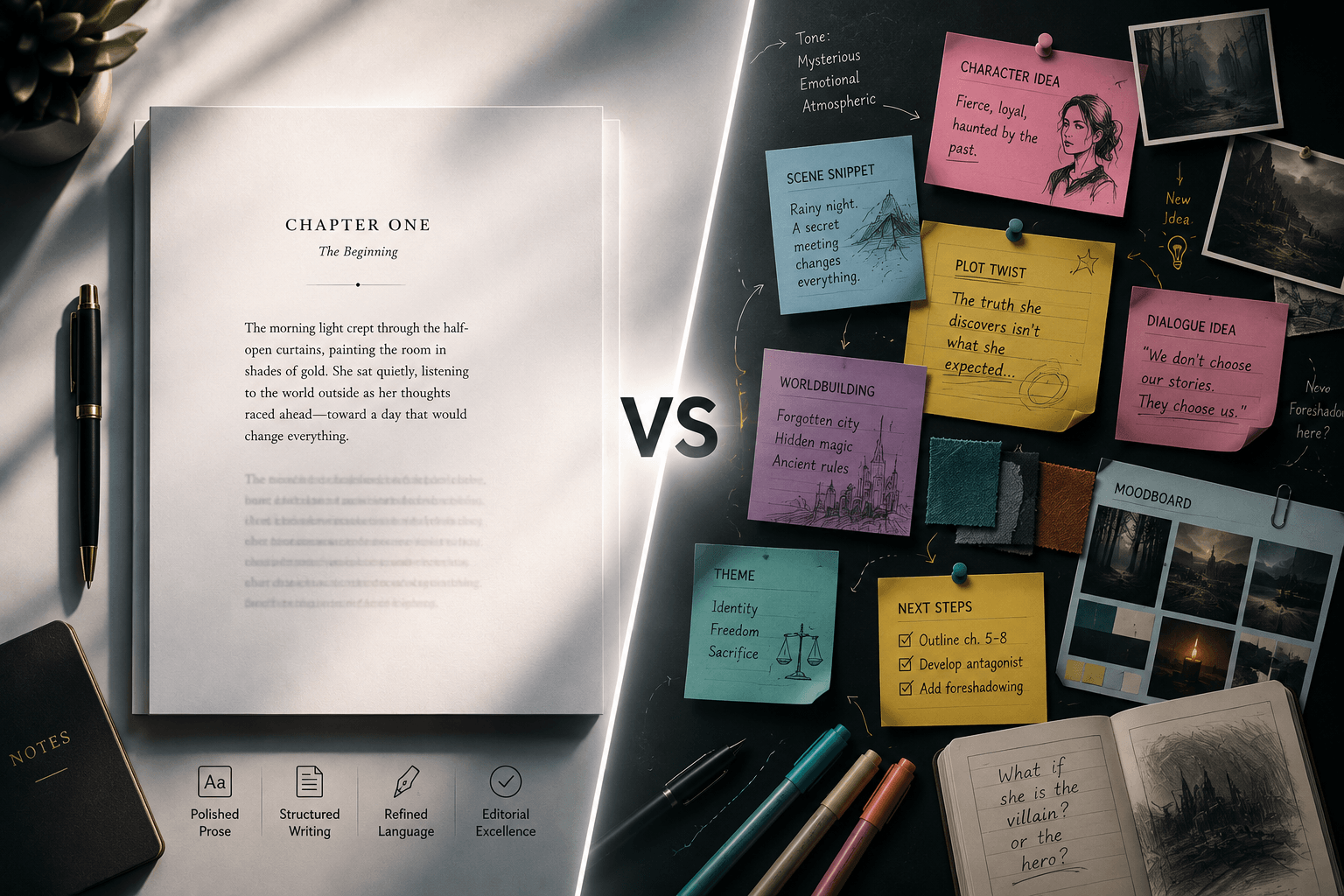
Claude writes calm, well-structured prose, but it was never built only for fiction. It was built to be a careful, broadly capable assistant, and that caution shows up in creative work as flatter emotional peaks, safer plot choices, and dialogue that sometimes sounds like everyone read the same etiquette guide. If you write novels, short stories, screenplays, or long-running fanfiction, the best Claude alternative for creative writing depends on what stage you’re stuck at: blank page, thin scene, forgettable dialogue, or a manuscript your current tool keeps losing track of.
This isn’t a “Claude is bad” article. Claude is genuinely strong at structural edits, thematic consistency, and prose that doesn’t need heavy cleanup. But fiction has different demands than a blog post or a business email, and several tools below are built specifically for those demands in ways Claude isn’t.
What Creative Writing Actually Needs From an AI Tool
Fiction writing needs three things a general chatbot doesn’t always prioritize: sustained memory of characters and plot across tens of thousands of words, flexible scene generation, and integrations that fit into a writer’s daily workflow. If you’re interested in how AI ecosystems are expanding beyond writing, our guide on everyday AI integrations explains how these tools are becoming more useful across different tasks.
I tested this directly by feeding the same 400-word scene setup, an argument between two estranged siblings, into six tools. Claude’s version was well-punctuated and coherent, but three of the six sentences opened with a character’s name, and the emotional register barely moved from start to finish. Sudowrite’s version had rougher edges but two lines of dialogue I’d have kept. That’s the trade-off this whole category is built around: polish versus range.
Sudowrite: Built Only For Fiction
If fiction chops are your only criteria, Sudowrite is usually the first name that comes up. It’s the most fiction-specific tool on this list, and it shows in the details. Its Story Bible feature holds character sheets, world rules, and an outline in one place, so the model has context most general assistants lose after a few thousand words. The Describe, Expand, and Brainstorm tools are built around scene-level work rather than full-document generation.
Pricing runs on a credit system rather than a flat monthly rate, which trips people up. As of 2026, the Hobby plan is $19/month billed monthly (or roughly $10/month if paid annually) with 225,000 credits, Professional is $29/month with 450,000 credits, and Max runs $59/month. Credits don’t map 1:1 to words; the Expand feature burns through them faster than Brainstorm does, so a heavy scene-writer can chew through the Hobby tier in days rather than weeks. A free trial gives you about 10,000 credits with no card required, which is enough to judge fit before paying.
Sudowrite isn’t trying to replace a general assistant for outlining a query letter or drafting a synopsis for an agent. It’s a scene-generation engine, and it’s the strongest one built for novelists specifically.
NovelAI: For Long-Running Fiction and Roleplay
NovelAI takes a different approach: instead of a chat interface, it’s built around continuous story writing with a persistent memory system called the Lorebook, where you define characters, locations, and plot threads that get pulled into context automatically as the story continues.
Three tiers exist: Tablet at $10/month with unlimited text generation and 1,000 Anlas for image credits, Scroll at $15/month with a larger context window, and Opus at $25/month with the largest memory. Full specifics on token limits per tier are laid out in NovelAI’s own subscription documentation. There’s no annual discount, and no ongoing free tier beyond a roughly 100-generation trial.
NovelAI is a genuine Claude alternative for creative writing if your project is long-form serialized fiction, tabletop-style roleplay, or fanfiction where content restrictions elsewhere become a real obstacle. It’s also independently run by Anlatan rather than a major AI lab, which matters to writers who specifically want a smaller company handling their manuscripts. The trade-off: prose coherence over very long stretches still needs manual correction more often than Sudowrite or Claude.
ChatGPT: The Best All-Around Brainstorming Partner
Among general-purpose picks, ChatGPT is the most complete Claude alternative for creative writing available right now, not because its prose is the most literary, but because the whole workflow around it, from ideation to revision, is more mature. If your bottleneck is the blank page rather than scene polish, ChatGPT (Plus at $20/month, same price as Claude Pro) tends to generate more divergent plot directions per prompt. Ask for five ways a chapter could end and you’ll typically get five genuinely different ones, where Claude often circles back to a similar emotional resolution even when told to vary it.
The Canvas editing interface is a real advantage for revision work, letting you highlight a paragraph and ask for a rewrite without regenerating the whole response. For writers producing at volume, that interface difference saves real time over a back-and-forth chat window.
Where ChatGPT struggles is manuscript-length consistency. Past roughly 15,000 words of story context in a single conversation, character details start drifting unless you actively re-paste a reference sheet. Claude’s larger context handling is genuinely better here.
Gemini: The Free Option Worth Taking Seriously
Gemini’s free tier is the most usable no-cost option for fiction work right now. It handles long inputs well, which matters if you’re feeding it research notes, outlines, or previous chapters and asking it to draft from that material rather than from a bare prompt.
It’s not the most literary voice among these tools. Reviewers and writers consistently describe its prose as competent rather than distinctive, which is fine for early drafts and outlining but means heavier editing later. If budget is the main reason you’re shopping around, start here before paying for anything.
DeepSeek: Cheapest Option With Real Creative Output
DeepSeek is the outlier on this list because it’s both free to use on the web and dramatically cheaper via API, priced around $0.14 per million input tokens, a fraction of what comparable models from other labs charge. It has become a surprisingly common answer to the Claude alternative for creative writing question among budget-conscious writers. Multiple people working in literary fiction have noted its prose leans more evocative and less safety-hedged than Western chatbots by default.
The catch is consistency. DeepSeek’s output quality varies more session to session than Claude’s, and its instruction-following on detailed style guides is less reliable. For high-volume, low-budget drafting where you’re doing heavy human editing anyway, it’s worth the zero-to-low cost. For a client deliverable you can’t babysit closely, it’s riskier.
Grok: Sharpest Personality, Best For Dialogue
Grok’s strength is voice. Its dialogue tends to sound less generically polite than Claude’s or ChatGPT’s default register, which makes it useful specifically for banter-heavy scenes, argumentative characters, or comedy where flat, safe phrasing kills the joke. It’s a narrower tool than the others here; its narrative prose outside of dialogue doesn’t hold up as well over long passages.
When Claude Is Still The Right Call
Reading a Claude alternative for creative writing list shouldn’t be mistaken for a case against Claude itself. Writers who already rely on Claude for editing may also appreciate the platform’s growing ecosystem of integrations. You can learn more about those capabilities in our article on new connectors in Claude for everyday life.
It remains a strong pick for four specific jobs: developmental editing on a finished draft, maintaining a consistent voice across a long manuscript once the prose exists, thematic and structural feedback, and any scene requiring restraint rather than intensity, like a quiet grief scene where an overwrought AI model tends to overwrite. Claude Pro costs $20/month ($17/month billed annually, per Anthropic’s current pricing page), the same price point as ChatGPT Plus, and its 200K-token context window still outperforms most competitors for holding an entire manuscript in memory during a single editing pass.
The realistic setup many working writers land on isn’t one tool. It’s Claude or ChatGPT for outlining and structural notes, Sudowrite or NovelAI for scene-level prose generation, and a human pass at the end that no AI model replaces. If you’re publishing that finished work anywhere online, a platform built for writer submissions, like the guest publishing options covered here, is a separate but related piece of the puzzle once the writing itself is done.
Frequently Asked Questions
Is there a completely free Claude alternative for creative writing?
Gemini’s free tier is the most capable no-cost option for drafting and brainstorming. DeepSeek’s web version is also free and produces genuinely usable creative prose, though output consistency varies more than paid tools.
Which tool is best for a full novel manuscript?
NovelAI and Sudowrite are both built around sustained fiction projects, with dedicated memory systems for characters and plot. Claude’s large context window is also strong for editing a completed draft in one pass.
Do these tools work for screenwriting, not just prose fiction?
ChatGPT and Claude both handle screenplay formatting reasonably well with clear prompting. Sudowrite is prose-focused and less suited to script format specifically.
Why does Claude feel “safer” than these alternatives for fiction?
Claude is tuned as a general-purpose assistant first, which tends to produce steadier emotional pacing and fewer risky narrative choices. That’s an advantage for editing and structure, and a limitation for raw creative intensity.
Is Sudowrite worth $19 to $59 a month compared to a general chatbot?
It depends on output volume. Writers generating scene-level prose daily typically get more value from Sudowrite’s fiction-specific tools than from a general assistant. Occasional or early-stage writers often get enough from a free or $20/month general tool.
Can I combine more than one of these tools in the same project?
Yes, and many working writers do. If you’re new to AI-assisted writing, it’s also worth understanding the broader history and evolution of large language models, which explains why different tools excel at different creative tasks. A common setup pairs a general assistant for outlining and edits with a fiction-specific tool like Sudowrite or NovelAI for scene drafting, since the two solve different parts of the process.
