

Ask five pricing pages what the cheapest API call costs right now and you’ll get five different answers, each stated with total confidence. That’s not because anyone is lying. It’s because the answer changes on a rolling basis, sometimes weekly, and most guides freeze a snapshot and call it current.
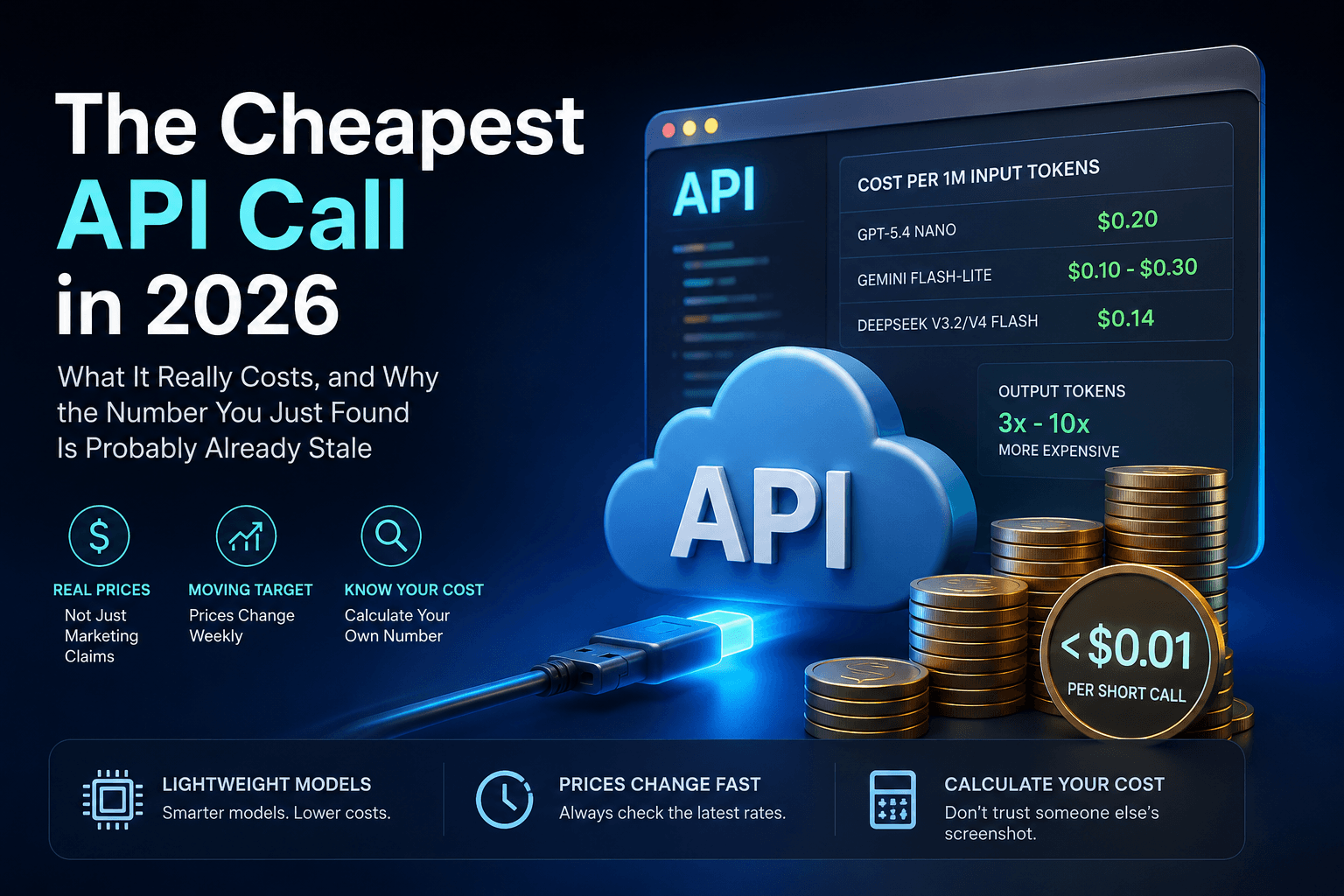
Here’s the direct answer: as of early August 2026, the cheapest API call from a major provider runs somewhere between $0.05 and $0.30 per million input tokens for lightweight models like GPT-5.4 Nano, Gemini Flash-Lite, or DeepSeek’s budget tier, with output tokens costing three to ten times more. In practice, a single short call, the kind used for classifying a support ticket or tagging a product description, typically costs less than a hundredth of a cent once you account for what actually happens inside that call.
That last part matters more than the headline rate. A lot of people search for the cheapest API call expecting a single clean number, and what they find instead is a swamp of conflicting figures. This article explains why that happens, what a call actually costs once you strip away the marketing, and how to work out your own number instead of trusting someone else’s screenshot.
What “cheapest API call” actually means
A “cheap API call” isn’t one thing. It’s the product of three separate variables: the per-token rate for the model you pick, how many tokens your specific call uses, and which discounts you’re eligible for at the moment you send the request.
Providers advertise price per million tokens, not price per call, because call size varies wildly. A one-word classification call might use 40 tokens total. A document-summarization call might use 20,000. Multiplying the same $0.20-per-million rate by those two workloads gives you $0.000008 versus $0.004, a 500x spread on the exact same model. So when someone says “the cheapest API call is $0.03,” they almost always mean the cheapest per-million-token rate, not the cheapest actual call. Confusing the two is the single most common mistake in this whole topic, and it’s why so many budget estimates are off by an order of magnitude.
The real price floor right now, and why it keeps sliding
Pulling from the current published rates across the major labs, the rock-bottom input tier looks roughly like this in August 2026:
- OpenAI’s smallest model, GPT-5.4 Nano, lists at $0.20 per million input tokens and $1.25 per million output tokens.
- Google’s Gemini Flash-Lite line sits around $0.10 to $0.30 per million input tokens depending on which generation you’re quoted (more on that below), with output landing near $0.40 to $2.50 per million.
- DeepSeek’s budget-tier model, V3.2/V4 Flash, has been quoted around $0.14 per million input and $0.28 per million output, making it one of the cheapest capable models by list price.
- Anthropic’s Claude Haiku 4.5 holds steady at $1.00 per million input and $5.00 per million output. It isn’t the rock-bottom number on this list, but it’s the most stable one, which is worth something on its own.
None of those numbers are wrong exactly, but every one of them is a moving target. Model families get renamed and re-tiered every few weeks now. Gemini alone has shipped Flash-Lite variants under three different version numbers since early 2026, and two aggregators checked five days apart quoted input prices that differed by 3x for what was nominally the “same” tier, because one was still showing the older 2.5 generation and the other had already rolled forward to 3.5. That’s not a rare glitch. It’s the normal state of this market right now, and it’s the biggest reason cost comparisons age badly within weeks of publishing.
Why every pricing article disagrees with the next one
This is worth spelling out because it’s the part most guides skip. Pull up ten “LLM API pricing” articles today and you’ll find at least four different prices claimed as “the cheapest API.” Some of that is genuine disagreement about what counts (open-weight models running on your own GPU aren’t really an “API call” in the billing sense). But most of it comes down to timing. A page last verified in April is quoting a model that has since been discounted, renamed, or quietly deprecated. Pricing aggregators that update daily still lag official pages by hours, and official pages themselves sometimes list promotional rates that expire on a specific date buried in a footnote.
A concrete example: Anthropic’s Claude Sonnet 5 is currently priced at an introductory $2.00 per million input and $10.00 per million output. That rate reverts to the standard $3.00/$15.00 on September 1, 2026. If you’re building a budget around Sonnet 5 today, that’s a 50% cost increase arriving in a few weeks, and no snapshot article written before this notice will mention it. That’s the kind of detail that a cost estimate needs and a generic comparison chart never carries.
The practical takeaway: treat every number in this article, and every other one you read, as directional rather than exact. Check the provider’s own pricing page before you commit budget to a model, especially if you’re planning for a launch more than a month out.
The hidden costs baked into every “cheap” call
Here’s something the sticker price hides completely: most of your input tokens on a real production call aren’t the user’s message at all. If you’re running a support-ticket classifier with a 600-token system prompt and a 900-token tool schema for function calling, and the user’s actual ticket is 80 tokens, you’re paying for roughly 1,580 input tokens on a call that “should” have cost 80 tokens’ worth. That overhead doesn’t shrink just because you picked the cheapest model on the price list. It shrinks when you trim the system prompt, cut unused tools from the schema, or cache the parts that don’t change between calls.
This is also where output length quietly wrecks a lot of budgets. Output tokens cost three to eight times more than input tokens across nearly every provider. A model that reasons through a problem step by step before answering, even a cheap one, can burn far more in output tokens than a pricier model that answers directly. If you’re optimizing for the cheapest API call, capping max output tokens and trimming verbose system instructions usually saves more money than switching providers.
Caching and batching change the math more than model choice does
Two levers move the real cost of a call further than almost anything else, and both are underused. Prompt caching, offered by Anthropic, OpenAI, and Google in slightly different forms, charges roughly 10% of the standard input rate for content that repeats across calls, like a long system prompt or a document you’re querying repeatedly. On a workload where 80% of your input tokens are a static system prompt, caching alone can cut your effective input cost by 60 to 70%.
Batch processing is the other lever. Submit requests asynchronously with a turnaround of up to 24 hours, and most providers cut the price in half, sometimes more when stacked with caching. For anything that doesn’t need a live response, nightly content tagging, backfilling old data, generating first-draft product descriptions in bulk, batch mode is close to free money left on the table if you’re not using it. The catch is real: you lose the instant response, so it’s wrong for anything user-facing in real time.
Stack caching and batching together on a workload with a heavy static prompt, and the effective price can drop to roughly a quarter of the sticker rate. That’s a bigger swing than switching from, say, Sonnet to Haiku, and it’s far less disruptive to your output quality.
How to actually calculate your cost per call
Skip the marketing numbers and do this instead. Take one real prompt from your actual use case, system prompt and tool definitions included, and run it through a tokenizer to get an exact input count. Estimate your typical output length from a handful of test runs rather than guessing. Then apply this formula:
(input tokens ÷ 1,000,000 × input rate) + (output tokens ÷ 1,000,000 × output rate) = cost per call
A worked example: a content-tagging call with a 250-token system prompt, a 150-token article excerpt, and a 30-token output, run on a $0.20/$1.25 nano-tier model, costs (400/1,000,000 × 0.20) + (30/1,000,000 × 1.25) = $0.00008 + $0.0000375 = roughly $0.00012 per call. At 50,000 calls a month, that’s about $6. The same call on a $3/$15 mid-tier model costs closer to $0.0015 per call, or $75 a month for the identical workload. Same task, 12x price difference, and neither number resembles the “$0.03 per million tokens” headline that started the search.
Picking a model by task, not by lowest price alone
The cheapest model per token is rarely the cheapest per finished task, because a weaker model that needs a retry or produces output you have to fix by hand isn’t actually saving anything. For simple, high-volume work like classification, tagging, short extraction, or routing, a nano or flash-tier model in the $0.05 to $0.30 range is usually the right call and the quality gap barely matters. If you’re evaluating providers beyond pricing, our guide to the best Claude alternative compares several strong options for different workloads and budgets.
For anything involving nuanced writing, multi-step reasoning, or customer-facing tone, stepping up to a mid-tier model like Haiku 4.5 or a comparable $1 to $3 tier model tends to reduce costly retries enough to pay for itself. Reserve frontier-tier pricing for tasks where accuracy failures are expensive: legal review, medical-adjacent content, or anything where a wrong answer costs more than the token savings ever could. If you’re weighing Claude specifically against other assistants for this kind of budget planning, our breakdown of Claude Pro vs ChatGPT Pro usage rates covers how the subscription side compares, which is a separate question from API pricing but one people often mix up.
The one thing worth doing this week
If you’re already spending real money on API calls, don’t just compare per-token rates. Pull your actual usage logs, split them by static overhead (system prompt, tool schemas) versus variable content (user input, retrieved documents), and check what percentage is repeating unchanged across calls. That number tells you exactly how much prompt caching would save before you touch a single line of code, and it’s a more accurate cost lever than swapping to whatever model currently has the lowest advertised price. Most teams never run this check and end up optimizing the 20% of their bill that model selection controls while ignoring the 60% that caching could have erased.
Once you’ve identified your real usage pattern, it’s also worth comparing different AI providers instead of focusing only on token costs. Our review of the best Claude alternative explores which models deliver the best value depending on speed, reasoning quality, and pricing.
FAQ
Is there a truly free API call for LLMs?
Most major providers offer limited free tiers, small daily credits or a request cap, meant for testing rather than production. Google’s Gemini free tier is currently the most generous at roughly 1,500 requests a day on Flash models. None of them scale to real production traffic without payment.
Why do the same model’s prices differ between articles?
Version churn and update lag. Providers rename and re-tier models every few weeks, and most third-party pricing pages update on a delay. Understanding how an application programming interface (API) works can also make pricing structures easier to interpret. Always check the provider’s own current pricing page before budgeting.
Does a gateway or router ever beat going direct to the provider?
Sometimes, mostly through access to flex or spot-priced capacity and automatic routing to whichever model is cheapest for a given request. On many models the token price itself is identical to going direct, and the gateway’s value is in routing and failover rather than a lower sticker price.
Is Batch API worth it for a small project?
Yes, if your workload can tolerate a delayed response. The 50% discount applies regardless of volume, so even a hobby project doing nightly processing benefits the same percentage as an enterprise pipeline.
Does prompt caching help if my prompts are all different?
Only the shared, repeated portion benefits, typically the system prompt or instructions. If every call is genuinely unique with no repeated content, caching won’t move your bill much.
