

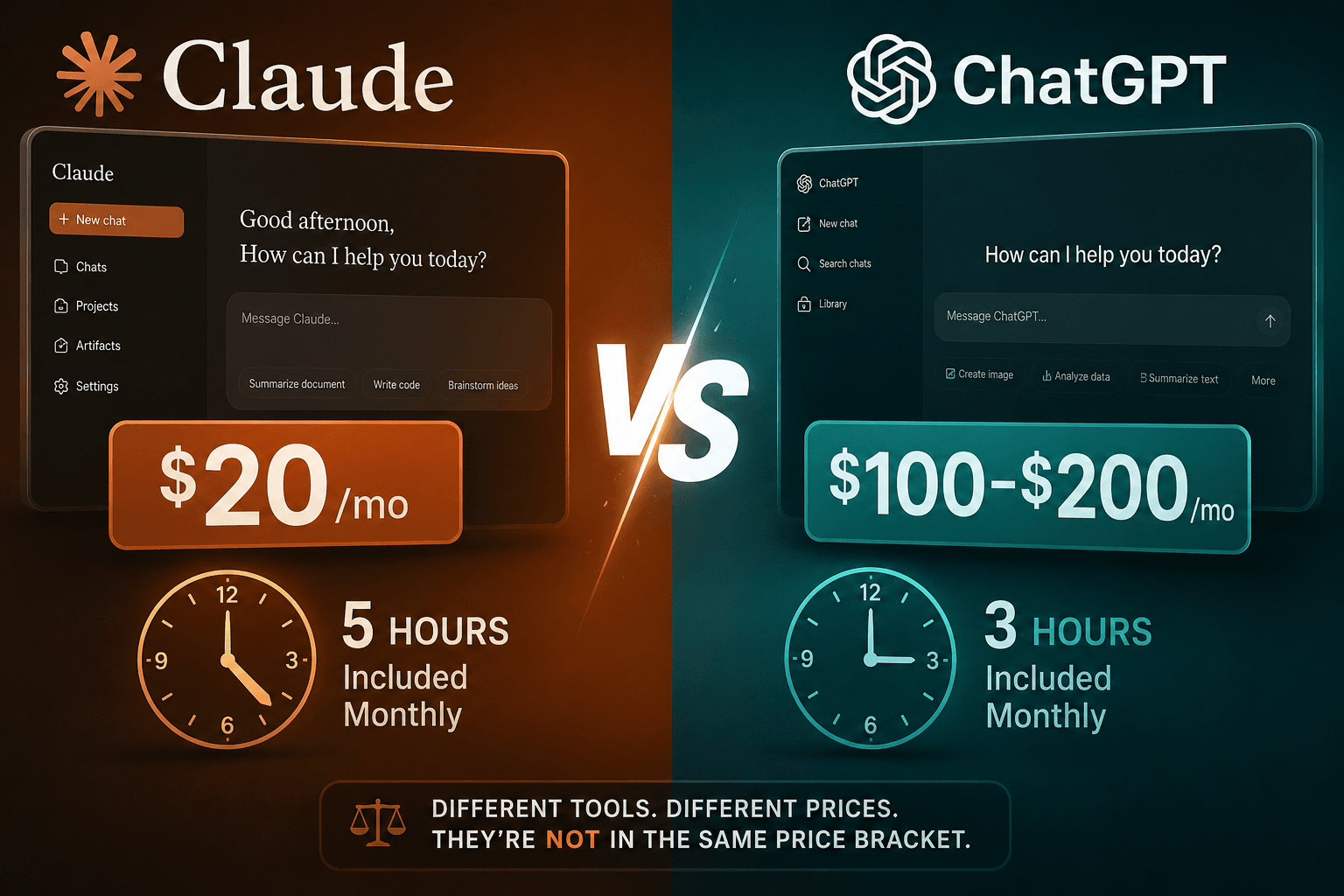
Here’s the confusion nobody clears up first: Claude Pro and ChatGPT Pro are not priced against each other. Claude Pro is Anthropic’s $20-a-month entry-level plan, while ChatGPT Pro is OpenAI’s premium tier that starts at $100 and climbs to $200. If you’re comparing Claude Pro usage rates against ChatGPT Pro, you’re really comparing a $20 subscription to a $100 or $200 one, and the usage allowances scale accordingly. That naming mismatch trips up more buyers than any actual feature gap does.
Why the Names Don’t Match Up
Anthropic and OpenAI built their tier ladders differently, and it shows in the labels. Claude’s lineup runs Free, Pro ($20), Max 5x ($100), and Max 20x ($200). OpenAI’s runs Free, Plus ($20), Pro ($100), and Pro ($200). So the plan that actually sits opposite ChatGPT Pro on price is Claude Max, not Claude Pro.
I’ve watched people sign up for Claude Pro expecting ChatGPT Pro-level headroom, then get frustrated within a week of heavy Claude Code use. They weren’t wrong to expect more. They just bought the wrong tier for what they wanted to do. If your budget is $20, you’re picking between Claude Pro and ChatGPT Plus. If your budget is $100 or $200, you’re picking between Claude Max and ChatGPT Pro.
What $20 Gets You on Each Side
Claude Pro costs $20 a month, or $17 a month if you pay $200 upfront for the year. It includes Claude’s full model lineup, Claude Code access from your terminal, unlimited Projects, and extended thinking for harder problems. Usage runs on a five-hour rolling session window rather than a fixed daily cap, and Anthropic layers a weekly limit on top of that so the plan can’t be used around the clock at full intensity. If your main goal is storytelling, blogging, or long-form content creation, it’s also worth exploring this detailed guide on Claude alternatives for creative writing before choosing a subscription.
ChatGPT Plus, OpenAI’s equivalent $20 tier, gives you roughly 160 messages on the flagship chat model per rolling three-hour window, about 3,000 reasoning-model messages a week, and 10 Deep Research reports a month. For a typical writer or researcher sending a few dozen messages a day, that ceiling rarely gets touched. The number that actually matters here isn’t the model name, it’s the reset window: Claude measures usage in five-hour blocks, OpenAI in three-hour blocks, and that difference changes how a heavy afternoon session feels on each platform.
What ChatGPT Pro Actually Costs
ChatGPT Pro splits into two tiers since OpenAI added a cheaper option in April 2026. The $100 tier gives five times the Plus usage allowance, access to the reasoning-heavy Pro-grade model, and a Codex coding allowance that launched at 10x Plus before settling to 5x after the introductory promotion ended. The $200 tier multiplies that further to twenty times Plus limits and adds close to a million tokens of context window, along with around 250 Deep Research runs a month.
One thing worth clearing up here, because a lot of pricing pages still get it wrong: Sora stopped being a standalone app inside ChatGPT in April 2026. If you see a comparison still listing “unlimited Sora video” as a Pro perk, treat that as outdated information carried over from an older version of the plan.
Both Pro tiers unlock the same underlying models. The only real difference between them is headroom and a few extras like the Operator agent. OpenAI itself has said Plus covers roughly 95% of users, which tells you Pro at either price is built for people who already know they’re hitting a wall, not people guessing they might.
What Claude Max Costs, Since That’s the Real Comparison
Claude Max mirrors ChatGPT Pro’s structure almost exactly: two tiers, same models, different ceilings. Max 5x runs $100 a month and gives five times Claude Pro’s usage inside every five-hour session. Max 20x runs $200 a month for twenty times that allowance, plus higher output limits per response. Neither Max tier changes which models you can reach; Claude Pro, Max 5x, and Max 20x all include the same current model lineup, including Claude Sonnet 5, which became the default chat model at the end of June 2026.
This is the cleanest apples-to-apples comparison available. At $100, Claude Max 5x and ChatGPT Pro’s $100 tier both promise 5x their respective base plan’s usage. At $200, Claude Max 20x and ChatGPT Pro’s $200 tier both promise 20x. The multipliers match. What differs is what counts against your allowance and how forgiving the reset window feels in practice.
Where the Two Actually Diverge: Shared Usage Pools
Here’s a detail that a lot of comparison pages skip entirely. On a Claude subscription, chat on web and mobile, Claude Code in your terminal, and Claude Cowork all draw from the same shared token pool. A developer running long Claude Code sessions in the afternoon can walk into an empty allowance for evening chat use, because everything comes out of one bucket.
ChatGPT keeps its allowances more separated by product. Deep Research runs are counted independently from chat messages, and Codex usage on the Pro tiers is tracked as its own multiplier rather than folded into general chat limits. If you split your time between coding and regular chat, that separation on the ChatGPT side can actually stretch a subscription further than the pooled model does on Claude, even at the same price point.
A Real Numbers Example
Say you’re a solo developer who runs Claude Code for about three hours most afternoons, mostly on Sonnet-class models, plus some regular chat use in the evening. Anthropic’s own usage data put average Claude Code spend around $6 a day for developers on the API, with 90% of users staying under $12 a day. On Claude Pro, three focused hours of agentic coding is realistic before the five-hour window’s rate limit catches up, especially if you’re working across a large codebase with a wide context window.
On ChatGPT’s side, a comparable developer running Codex through Plus would hit the 160-messages-per-three-hours ceiling faster during multi-step agentic tasks, since each tool call and file read can consume more of that budget than a single chat reply does. That’s the practical reason OpenAI built the $100 Pro tier specifically around a Codex usage multiplier rather than just raising the chat message count.
Cost Per Unit of Usage: Which Multiplier Is the Better Deal
Comparing sticker price to multiplier, Claude Max 20x costs ten times the price of Claude Pro but grants roughly twenty times the usage, which makes it the better value per unit if you’ll genuinely use that much. The same math holds on the OpenAI side: ChatGPT Pro at $200 costs ten times Plus but delivers twenty times the allowance. Neither company gives you a linear price-to-usage ratio at the top tier; both reward heavy, consistent use rather than occasional bursts.
Where this breaks down is idle capacity. A $200 plan that goes unused most days is a worse deal than a $20 plan you actually fill up. Anthropic and OpenAI both know this, which is why their own marketing leans on “do you hit the limit” as the real qualifying question rather than any stated price comparison.
When the API Beats Either Subscription
For programmatic or automated workloads, subscription pricing on either platform can lose to pay-per-token API billing. Anthropic’s Claude Sonnet API pricing runs around $3 per million input tokens and $15 per million output tokens as of mid-2026, with no monthly minimum. OpenAI prices its flagship model API access separately from ChatGPT subscriptions as well.
If you’re sending a few hundred interactive messages a day through a chat interface, a flat subscription almost always wins on cost. If you’re running scheduled batch jobs or building an app on top of either model, raw API pricing usually wins instead, because you only pay for what you actually process. If you’re unfamiliar with how large language models work under the hood, this overview of transformer-based language models provides useful background
Which One Should You Actually Buy
If your total AI spend is capped at $20, the honest comparison is Claude Pro against ChatGPT Plus, not against ChatGPT Pro. Claude Pro tends to suit people who already lean on Claude Code or want a longer effective context window in daily use. ChatGPT Plus tends to suit people who want a wider spread of built-in tools like image generation and voice mode without paying more. Writers who prioritize brainstorming, fiction, and polished long-form drafts should also compare these Claude alternatives for creative writing to see which platform better fits their workflow.
If you’re past $20 and weighing genuine power-user plans, then Claude Max and ChatGPT Pro are the real contest. Pick Max if your work is code-heavy and you already trust Claude’s agentic coding behavior. Pick ChatGPT Pro’s $100 tier if you want Codex plus a wider general toolset in one place, and only reach for the $200 tier if you’re regularly pushing past a half-million tokens of context or you need the higher Deep Research allowance.
The One Thing Worth Checking Before You Buy
Before comparing price tags, track your own usage for a week on whichever free tier you’re already using. Anthropic and OpenAI both publish rate-limit dashboards inside their apps now, and the honest test isn’t which plan sounds more generous on a pricing page, it’s whether you actually hit a wall during a normal week. Most people never do, and the $80 to $180 difference between the entry plan and the power-user tier is better spent finding that out first than guessing from a comparison article, including this one.
Frequently Asked Questions
Is Claude Pro the same price as ChatGPT Pro?
No. Claude Pro costs $20 a month. ChatGPT’s plan actually called “Pro” starts at $100 a month and goes up to $200. The $20 ChatGPT tier is named Plus, not Pro, which is the source of most confusion in this comparison.
Does Claude Pro include Claude Code?
Yes. Claude Pro includes terminal access to Claude Code, but usage draws from the same five-hour session pool as web and mobile chat, so heavy coding sessions can reduce what’s left for other use that day.
Which plan gives more usage for $100: Claude Max 5x or ChatGPT Pro?
Both promise roughly 5x their respective $20 base plan. In practice, Claude’s pooled usage across chat, Code, and Cowork can feel tighter for mixed workloads, while ChatGPT separates Codex and chat allowances, which can stretch further if you split your time between the two.
Do usage limits reset daily?
Neither does. Claude uses a five-hour rolling session window plus a separate weekly cap. ChatGPT Plus and Pro use a three-hour rolling window for chat messages, with Deep Research and Codex tracked on their own monthly or weekly counters.
Is the API cheaper than a Pro subscription?
It depends on your usage pattern. For regular interactive chat, a flat subscription is usually cheaper than paying per token. For automated or high-volume programmatic tasks, API billing, currently around $3 per million input tokens for Claude’s Sonnet model, tends to come out ahead.
Should a small team buy individual Pro plans or a Team plan?
Once you’re past two or three people, Team plans usually win. Claude Team starts at $25 per seat with centralized billing, and ChatGPT Business runs about $20 to $30 per seat depending on billing frequency, both undercutting what the same headcount would pay on stacked individual Pro subscriptions.
