

There is no single winner. That’s the honest answer, and if an article tells you otherwise, it’s probably trying to sell you something. The real question isn’t “which tool is best,” it’s “best for which part of the job.”
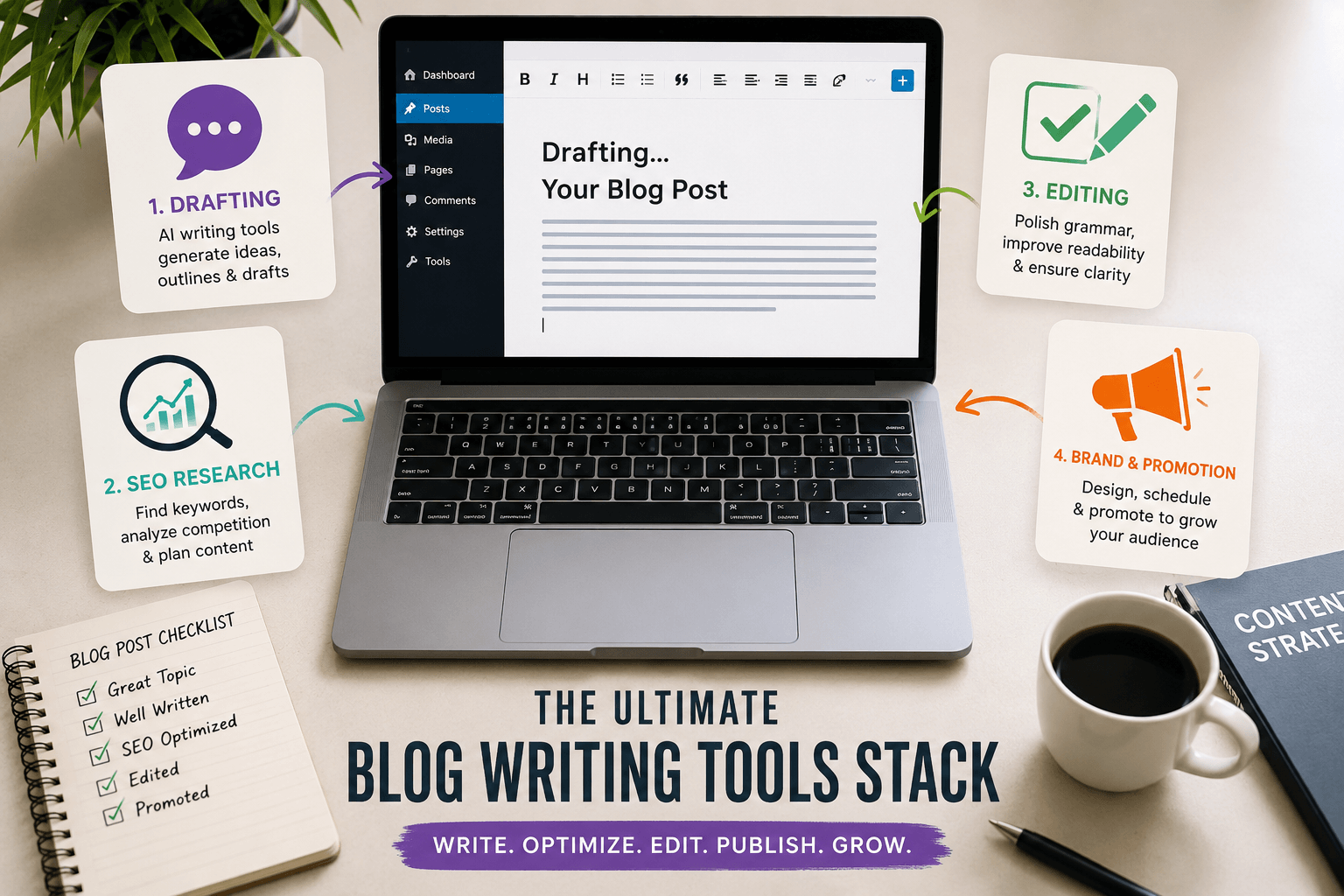
The best AI tools for content writing in 2026 fall into four jobs, not one: drafting (ChatGPT, Claude, Gemini), SEO research and briefing (Surfer, Frase), line editing (Grammarly, Wordtune), and brand-voice marketing copy at scale (Jasper, Copy.ai, Writesonic). Most working writers run two or three of these together rather than paying for one platform that claims to do everything.
I run content across a handful of niche sites, so this isn’t theoretical for me. What follows is what actually holds up when you’re publishing daily, not what looks good in a five-minute demo. If you’re also looking at the complete process from drafting to publishing, this article publishing guide is useful alongside the tools discussed below.
Why “one tool for everything” keeps disappointing people
Every all-in-one AI writing suite promises to handle research, drafting, SEO, and editing in a single dashboard. In practice, the drafting is usually decent, the SEO features are usually shallow, and the editing is usually an afterthought. That’s not a knock on any specific product. It’s a structural problem: building a genuinely strong large language model and building a genuinely strong SERP-analysis engine are two different, expensive disciplines, and few companies do both well.
So the practical move is to stop looking for one tool and start building a small stack. That’s less exciting to write about, which is probably why most roundup articles skip it.
The drafting engines: where the actual writing happens
This is the layer that produces your first draft, and it’s where the biggest gap between tools shows up.
ChatGPT Plus costs $20 a month and remains the broadest general-purpose option. It handles ideation, quick rewrites, and short-form copy well, and its plugin and image-generation ecosystem is still the widest of any chatbot. Where it struggles is holding a consistent voice across a long article. Ask it for a 2,000-word piece and you’ll often notice the tone drifting by section three.
Claude is the one I reach for on anything longer than 1,200 words. It’s noticeably better at keeping a consistent voice from the introduction to the conclusion, and it follows detailed style instructions (exact heading structure, no em dashes, keyword frequency ranges) more reliably than the other major chatbots in my testing. The Pro plan is $20 a month, or $17 a month billed annually, and includes Claude Code and Projects for keeping brand guidelines on hand between sessions, according to Anthropic’s own plan documentation.
Gemini is worth having open in a second tab specifically for research-heavy pieces, since it handles long, messy source notes and turns them into a workable outline faster than the others.
None of these three tools will hit your exact keyword density target, follow a rigid FAQ format, or match a brand’s specific voice guide out of the box. That’s a prompting and editing problem, not a tool problem, and no amount of subscription money removes the need for a human editing pass.
The SEO research layer: turning a topic into a brief
A blank page with no data behind it is how you end up writing 1,500 words that never rank. This is the layer most drafting tools skip entirely.
Surfer SEO analyzes the top-ranking pages for a keyword and builds a content brief with target word count, related terms, and a live scoring editor as you write. The Essential plan runs around $99 a month billed monthly, or roughly $79 a month if you commit annually, and includes about 30 Content Editor briefs a month. That’s a real cost per article, somewhere in the $3 to $4 range if you use your full allocation, which is worth knowing before you commit to a plan sized for a publishing pace you don’t actually have.
Frase does a similar job at a lower entry point, with plans starting under $20 a month, and it bundles a research summarizer that pulls answers from top-ranking pages into one view. It’s the more budget-friendly option for a solo writer who wants SERP data without a $99 line item.
Neither tool writes good prose on its own. What they’re actually good at is telling you what a topic requires before you write a single sentence, which is a different and genuinely useful kind of help.
The polish layer: catching what a first draft misses
Grammarly isn’t a generator, and it doesn’t try to be one anymore. Its value is in the second pass: catching passive voice creep, inconsistent tense, and sentences that technically parse but read awkwardly out loud. Running a draft through Grammarly after Claude or ChatGPT has written it catches a category of error that neither chatbot reliably flags in its own output, because they’re not built to proofread themselves.
Wordtune does something narrower and specific: it offers rewritten versions of individual sentences, which is genuinely useful when a sentence is correct but clunky, and you can’t quite see how to fix it yourself.
The brand-voice and marketing layer
If you’re writing for a single brand across dozens of pieces a month, and consistency matters more than raw drafting flexibility, this category exists for you.
For teams producing content across multiple formats, Invideo can complement these writing tools by helping turn campaign ideas and messaging into video content.
Jasper is built around a brand memory system that learns a company’s terminology and tone and applies it across every generated piece. The Pro plan costs $69 a month, or $59 a month per seat billed annually, and there’s no permanent free tier, only a short trial. It’s a real cost jump from a $20 chatbot subscription, and it’s aimed squarely at marketing teams managing multiple campaigns, not solo bloggers.
Copy.ai leans toward short-form and conversion copy, things like subject lines and ad variations, where speed matters more than long-form nuance.
Writesonic sits in between, offering long-form drafting plus some built-in SEO scoring, at a price generally lower than Jasper’s, which makes it a reasonable middle option for teams that can’t justify the jump to a full brand-voice platform yet.
A realistic stack, by budget
If you’re a solo blogger or freelancer publishing a handful of pieces a month, a $20 Claude or ChatGPT subscription plus free-tier Grammarly covers most of what you need. Add Frase’s entry plan once you’re serious about ranking, not before.
If you’re producing SEO content daily across one or two sites, the stack that has worked for me is a chatbot for drafting, Surfer or Frase for the brief, and Grammarly for the pass before publishing. That’s roughly $150 to $200 a month total, and it beats a single $69-plus all-in-one subscription that does each individual job less well. Once the article is ready, following a structured guide to publishing articles can also help keep the final publishing workflow organized.
If you’re managing brand voice across a marketing team, Jasper’s Pro or Business tier earns its price, but only once you have enough volume and enough writers that consistency, not raw output speed, is the actual bottleneck.
What’s genuinely different about 2026
Two things changed the way these tools get evaluated this year. First, Google’s ranking systems lean on semantic understanding rather than exact-match keyword density, so tools still selling you a strict keyword-count target are optimizing for a signal that matters less than it used to. Google has said directly that content quality and how it was produced matter far less than whether it demonstrates real expertise and originality. Second, AI Overviews and answer engines now pull directly from published content, which is why several SEO tools added “AEO” scoring on top of their traditional SERP analysis. Whether that scoring is meaningfully accurate yet is still an open question, and I’d treat any AEO score as a rough directional signal rather than a target to hit exactly.
Mistakes I still see people make
Publishing an unedited AI draft straight from a chatbot is the most common one. It’s usually detectable, not because of some magic AI-detection tool, but because the sentence rhythm doesn’t vary and the transitions feel mechanical. A five-minute human pass, tightening two or three sentences and adding one specific detail the AI couldn’t have known, fixes most of that.
The second mistake is buying a $99-a-month SEO tool for a publishing pace of two articles a month. Match the subscription to your actual volume, not your ambitions.
One thing worth doing that most guides skip
Run the same brief through two different chatbots and keep the better paragraphs from each, rather than picking one tool and living with its blind spots. Claude tends to write stronger transitions and structure; ChatGPT often generates sharper hooks and headline options. A ten-minute stitch-and-edit pass across both outputs consistently beats a single tool’s first draft, and it costs nothing extra if you’re already paying for both subscriptions.
Frequently Asked Questions
Is ChatGPT or Claude better for content writing?
Claude tends to hold a consistent voice better across long articles and follows detailed style instructions more reliably. ChatGPT has a wider feature set and plugin ecosystem. Many writers use both for different tasks.
Do I need an SEO tool if I’m already using an AI chatbot?
Yes, if ranking matters. Chatbots draft well but don’t know what’s actually ranking for your target keyword right now. A tool like Surfer or Frase fills that gap with live SERP data.
Can AI-written content actually rank on Google in 2026?
Yes, when it’s edited by a person and demonstrates real expertise or specific detail. Google’s guidance focuses on content quality and helpfulness, not on how the draft was produced.
What’s the cheapest realistic AI writing stack?
A $20 chatbot subscription plus a free-tier grammar checker covers most solo writers. Add a budget SEO tool once ranking becomes the priority.
Is Jasper worth it for a solo blogger?
Usually not. Jasper’s brand-voice and team features are built for marketing teams managing multiple writers and campaigns. A solo blogger typically gets more value per dollar from Claude or ChatGPT.
