

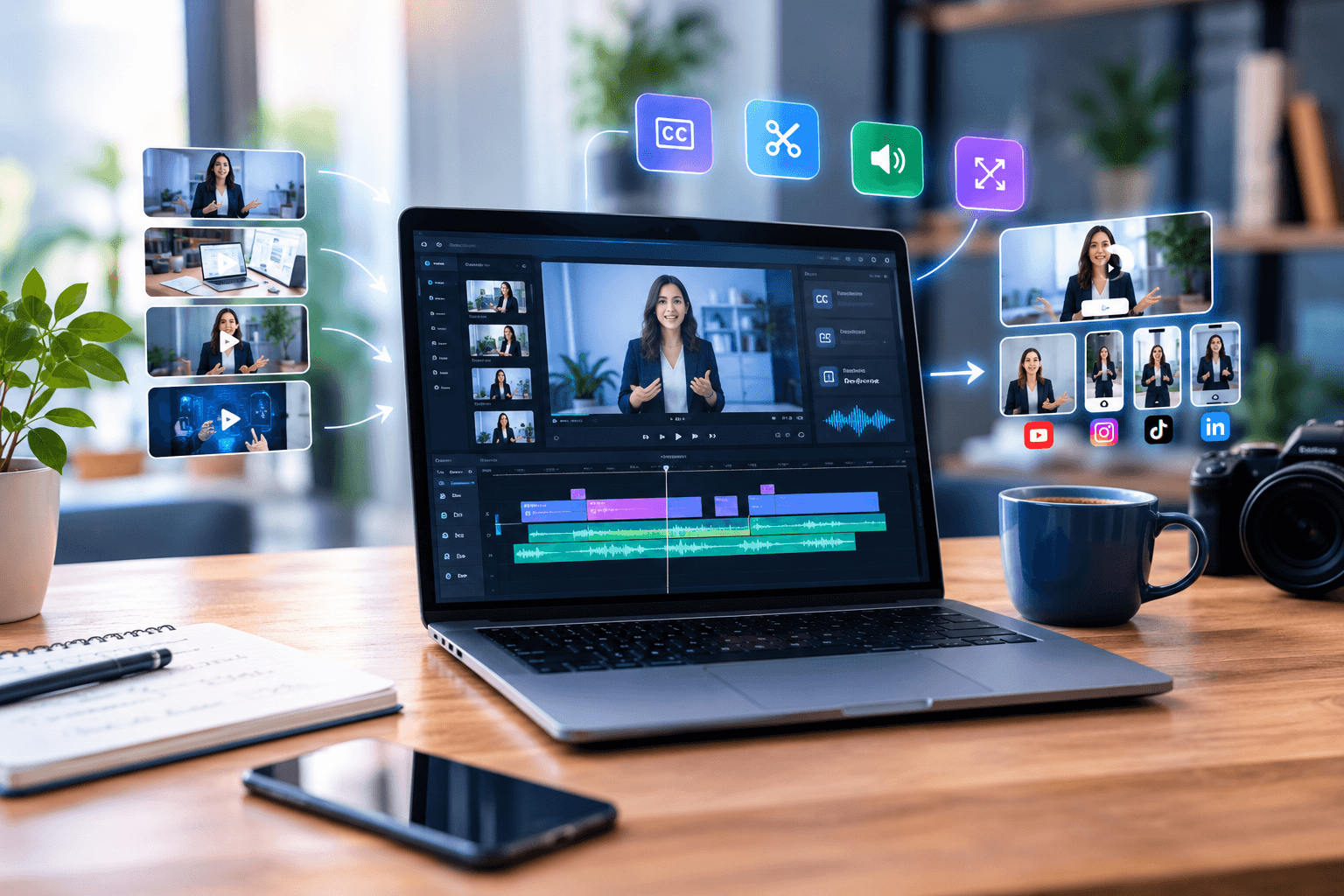
SaaS marketing teams need more video content across product demos, social media, tutorials, ads, and customer education. AI video editors are changing the workflow by reducing repetitive editing, speeding up revisions, and making content repurposing easier. The biggest benefit isn’t simply generating videos faster. It’s helping teams move from one-off production to a repeatable process where humans guide the message and AI handles more of the routine work.
Why are SaaS teams using more video?
Video has become a regular part of SaaS marketing, but producing enough of it can be difficult. A product team may need a demo for a landing page, a short social clip, a customer tutorial, and several ad variations from the same campaign.
That creates a production problem. Each version can require scripting, recording, editing, captions, voiceovers, resizing, reviews, and revisions.
The demand is already clear. Wyzowl’s 2026 video marketing survey found that 91% of businesses use video as a marketing tool, while 63% of video marketers said they had used AI video tools to create or edit marketing videos.
For SaaS companies, this matters because video can explain products that are difficult to understand from text alone. A short screen recording can show a workflow, while an explainer can make a complex feature easier to grasp.
The challenge is keeping production fast without making every video feel rushed or generic.
What does an AI video editor actually do?
An AI video editor uses artificial intelligence to assist with editing tasks such as removing unwanted sections, changing scenes, creating captions, adjusting audio, and producing different versions of existing content. Instead of handling every step manually, marketers can give instructions and let AI perform parts of the editing workflow.
Traditional editing still has an important role. You choose the story, review the footage, decide what matters, and make the final creative decisions.
An AI video editor changes how you get there.
For example, imagine a SaaS company records a 40-minute product walkthrough. The marketing team may want to turn it into:
- A five-minute product demo
- Three short social clips
- A customer onboarding video
- A sales enablement video
- A short feature announcement
Doing this manually can involve repeated cutting, captioning, resizing, and exporting. AI-assisted editing can reduce some of that repetitive work.
This is where the workflow becomes more important than simple video generation. The goal isn’t to press one button and accept whatever comes out. It’s to give marketers more control while reducing the amount of routine work between the raw footage and the finished asset.
For teams building a larger content operation, that difference can be significant.
How can AI video editors speed up SaaS workflows?
AI video editors can speed up SaaS content production by handling repetitive editing tasks and making revisions easier. Instead of rebuilding each asset from scratch, teams can work from existing footage, scripts, and edits, then create new versions for different audiences, channels, or campaign goals.
Consider a SaaS webinar.
The original recording might contain useful product explanations, customer questions, and feature demonstrations. An editor could manually search through the entire recording to find useful sections.
An AI-assisted workflow can help make that process more manageable.
The same principle applies to other common tasks:
Removing unnecessary sections: Long pauses, repeated takes, mistakes, and irrelevant sections can be identified and removed more quickly.
Creating variations: A single campaign video can become shorter versions for different social platforms or audiences.
Adding captions: Subtitles can reduce the manual work involved in transcribing and syncing dialogue.
Changing pacing: Teams can tighten sections that feel too slow without rebuilding the entire project.
Repurposing content: A webinar, interview, or product demonstration can become several smaller pieces of content.
The result is a shift from producing one video at a time to managing a content system.
That matters for SaaS teams because campaigns often need several related assets rather than one finished video.
From one video to many content assets
One of the biggest changes is the ability to treat existing content as raw material for new assets.
A SaaS company might already have a library of product demos, customer interviews, webinars, tutorials, and sales presentations. The problem isn’t always a lack of content. It’s that much of the existing material remains unused because repurposing it takes time.
An AI video editor can help reduce that friction.
For example, a 30-minute customer interview could provide material for:
- A customer story for the website
- Several short social clips
- A quote-led video for LinkedIn
- A product-use-case video
- A sales presentation section
- A short email campaign video
The human still needs to decide which moments are valuable. AI simply makes the mechanical parts of turning those moments into usable assets easier.
This also connects with other parts of the marketing workflow. Teams may use AI tools for content writing to develop scripts and messaging, then use AI video tools to turn those ideas into visual content.
For campaigns that need custom visuals, AI image generation tools can also become part of the creative process.
The larger trend is toward connected content workflows rather than isolated AI tools.
What is agentic video editing?
Agentic video editing goes beyond generating a video from a single prompt. It allows AI agents to handle connected editing tasks based on instructions, work through the project, and return an editable result that a person can review and refine.
This distinction matters for professional marketing teams.
A simple prompt might ask an AI system to create a video. An agentic workflow can instead involve several steps:
- Review the available footage
- Find relevant sections
- Assemble a first cut
- Make requested edits
- Adjust the pacing
- Apply changes across the timeline
- Prepare a version for review
The marketer remains responsible for the creative direction.
For example, a SaaS marketer might ask an agent to find the clearest explanation of a feature, remove unnecessary pauses, create a shorter cut, and prepare it for social media. The AI can handle connected production tasks while the marketer checks whether the result communicates the right message.
This approach can reduce repetitive manual work without removing human judgment.
The distinction is becoming more relevant as AI video creation moves beyond single prompts to directed workflows, where the goal is not just generating an asset but managing more of the production process.
Where does an AI video editor fit?
An AI video editor fits best when a team has recurring video work, existing footage, frequent revisions, or multiple content formats to produce. It can be especially useful when marketers spend more time on repetitive editing tasks than on creative decisions.
This is one area where Invideo editor can fit into a SaaS team’s workflow. Its browser-based editing workspace combines a multitrack timeline with AI-assisted editing, allowing users to work with their footage while bringing AI into parts of the editing process.
The broader invideo editor workflow can be useful for tasks such as reviewing footage, assembling edits, making changes, and refining the final timeline. The platform also supports manual editing, so the user can still control the project rather than simply accepting an automated result.
For marketers who already work with generated videos, an ai video editor can also help after the initial generation stage. Invideo’s AI video editor supports text-based commands for changes such as deleting scenes, changing voiceovers, and adjusting video elements.
That creates a useful distinction between generation and editing.
Generation helps create the initial material. Editing helps shape that material into something that fits a real campaign.
How should SaaS teams use AI without losing quality?
AI should handle repeatable production work, while people remain responsible for strategy, accuracy, brand voice, and final review. The strongest workflow is usually collaborative rather than fully automated.
A practical process looks like this:
1. Start with the marketing goal
Decide whether the video needs to explain a feature, generate leads, support sales, educate customers, or build awareness.
2. Define the audience
A product video for developers may need very different language from one aimed at business owners.
3. Create the first version
Use your existing footage, scripts, screenshots, or other assets as the foundation.
4. Let AI handle repetitive work
Use an AI video editor for tasks such as cutting unwanted sections, creating captions, adjusting versions, or making routine changes.
5. Review the result manually
Check facts, product details, visuals, pacing, audio, and brand consistency.
6. Create useful variations
Instead of making every asset from scratch, adapt the strongest version for different channels and audiences.
This approach also makes it easier to measure the actual value of AI. Don’t only track how quickly a video was produced. Look at whether the content improved engagement, leads, product understanding, or another business goal.
Wyzowl’s 2026 research found that 93% of video marketers said video helped increase understanding of their product or service, while 85% said it helped generate leads.
Those numbers don’t prove that AI itself causes better marketing results. They do show why teams continue investing in video and looking for more efficient ways to produce it.
For teams building a wider content workflow, resources such as free SEO tools can also help with topic research and performance measurement.
What changes for SaaS marketers next?
The biggest change isn’t that marketers can create videos with fewer clicks. It’s that video production can become a more continuous part of the content workflow.
Instead of planning one large video project, teams can build a system around existing content. A webinar can become social content. A product demo can become onboarding material. A customer interview can become a case study and sales asset.
An invideo editor can support this type of workflow by giving teams a place to work with footage, make edits, and use AI assistance where it saves manual effort. The current Invideo Editor also supports editable project exports for tools such as Premiere Pro, Final Cut Pro, and DaVinci Resolve, which can matter when a project needs to move into another editing workflow.
The important point is not to automate everything.
AI works best when it removes repetitive tasks and leaves people with more time for decisions that require context, taste, and judgment.
For SaaS teams, that can mean faster iteration without turning every piece of content into a generic template.
Conclusion
AI video editors are changing SaaS marketing by making video production more repeatable. Teams can work with existing footage, create variations, reduce repetitive editing, and move from one finished asset to a wider content system.
Three practical lessons stand out:
- Use AI for repetitive production tasks, not final creative judgment.
- Repurpose strong existing content before creating everything from scratch.
- Measure the business result, not just how quickly a video was produced.
Frequently Asked Questions
What is an AI video editor?
An AI video editor is software that uses artificial intelligence to assist with video editing tasks. Depending on the tool, this can include removing unwanted sections, generating captions, changing scenes, adjusting audio, creating variations, or responding to text-based editing instructions. The user still reviews the result and controls the final creative direction.
How can AI video editors help SaaS marketing teams?
They can reduce repetitive work involved in producing product demos, social clips, tutorials, customer videos, and campaign variations. A team can start with existing footage or generated content, then use AI assistance to cut, revise, caption, resize, and repurpose it. This can make recurring video production easier to manage.
Can AI video editors replace human video editors?
Not completely. AI can handle many repetitive tasks, but people still need to make decisions about storytelling, brand voice, product accuracy, pacing, visual quality, and audience needs. Human review is especially important for SaaS marketing because product claims and demonstrations need to be accurate.
What is the difference between AI video generation and AI video editing?
AI video generation focuses on creating new video content from inputs such as text, images, or scripts. AI video editing focuses on changing or improving existing material. Some platforms combine both workflows. Using them together can help a marketing team move from an initial idea to a finished campaign asset.
Is an invideo editor useful for SaaS content?
An invideo editor can be useful when a SaaS team needs to create and revise recurring video content. Invideo editor provides a browser-based timeline and AI-assisted workflows, allowing users to work with their own footage while using AI for parts of the editing process.
What SaaS videos can be created with AI?
Common examples include product demos, feature explainers, tutorials, onboarding videos, social clips, customer stories, sales videos, and video ads. The right format depends on the audience and marketing goal. Wyzowl’s 2026 research lists social media videos, explainers, testimonials, presentations, ads, and product demos among common business video uses.
How should teams measure AI-assisted video production?
Start with the same business goals you would use for any marketing content. Depending on the campaign, that might include qualified leads, product understanding, engagement, conversions, retention, or support volume. Also track production time and revision effort. Faster production matters, but it only becomes valuable when the resulting content serves a clear business purpose.
